



Image: LUAL Games KIG / Team17
What happens when understanding a monster becomes more dangerous than fighting it? Eldritch Empathy explores that question through a disturbing combination of puzzles, psychological pressure and moral choices. Instead of simply defeating supernatural creatures, players must uncover what is wrong with them.
LUAL Games KIG develops this narrative cosmic horror roguelite, and Team17 publishes it. It arrives on Steam for PC in 2027. Its unusual premise places emotional diagnosis at the center of encounters with Lovecraftian beings.
Every creature presents a problem to investigate. However, discovering its suffering is only half the challenge. Players must also decide whether that knowledge becomes an instrument of healing or destruction.
Eldritch Empathy begins with a mystery in the Swiss countryside
Eike is a young woman troubled by strange dreams. Near her quiet Swiss village, she begins seeing twisted creatures lurking in the surrounding woods. These encounters draw her toward a mystery that reaches far beyond ordinary village life.
Fortunately, she does not investigate alone. Ida, a scientist, becomes her mentor and helps guide her research into these mysterious beings. Together, their work provides the foundation for understanding creatures that initially seem impossible to comprehend.
The investigation extends through woods, mountains and mines, bringing Eike into contact with increasingly unsettling manifestations. Rather than treating each monster as an ordinary enemy, the adventure asks players to examine its condition.
That distinction gives the horror a particularly uncomfortable edge. Understanding something frightening does not necessarily make it harmless. Moreover, recognizing its pain creates a responsibility that players cannot simply ignore.
Diagnosing corrupted emotions changes how encounters work
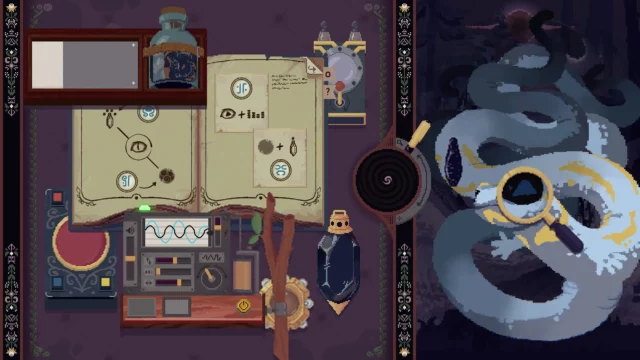
The central gameplay mechanic revolves around identifying a creature’s corrupted emotion. Players use investigative tools, accumulated research and careful observation to understand what each being is experiencing.
Deduction matters because the answer is not simply handed over. Instead, players eliminate possibilities until they identify the emotion responsible for the creature’s corruption.
Once that diagnosis is complete, another puzzle begins. Players manipulate and transform symbols to construct pathways through the creature’s insides. These routes allow Eike to approach the source of its suffering.
At that point, the same tools can serve two opposing purposes. A carefully constructed route can reach and purify the corrupted emotion. Alternatively, players can deliberately cause harm.
This creates a striking relationship between puzzle solving and moral responsibility. Finding a solution is not necessarily the same as making a compassionate decision.
The key gameplay elements of Eldritch Empathy include:
- Emotional diagnosis: Observe monstrous creatures and identify their corrupted feelings through deduction and research.
- Symbol manipulation: Transform symbols and build internal pathways to reach emotional corruption.
- Healing or harming: Decide whether to purify a creature’s suffering or use investigative tools destructively.
- Sanity management: Work efficiently because Eike gradually loses sanity as time passes.
- Roguelite progression: Turn unsuccessful attempts into knowledge, expanded research and stronger builds.
- Boss encounters: Face a boss at the end of every level.
- Lasting consequences: Make irreversible choices that affect the village and its community.
Sanity makes every investigation a race against time
Careful analysis sounds like the safest approach, but Eike cannot investigate indefinitely. Her sanity deteriorates as time passes, introducing pressure into every encounter.
Consequently, players must balance thorough observation against the danger of hesitation. Rushing a diagnosis risks misunderstanding a creature. Taking too long, meanwhile, comes with its own cost.
This tension also shapes the roguelite progression system. Failure does not erase everything Eike has learned. Each attempt contributes knowledge, expands her research and helps improve her build.
Repeated attempts therefore serve a narrative purpose alongside mechanical progression. Eike becomes better equipped to understand the horrors confronting her, even when an individual investigation ends unsuccessfully.
Each level culminates in a boss encounter, giving the journey another layer of challenge. Ultimately, her investigation leads toward the eldritch entity at the center of these cosmic horrors.
Healing monsters does not guarantee safety for the village
Perhaps the most unsettling element is the connection between individual decisions and the wider community. Eike’s actions have irreversible consequences for the village and its inhabitants.
That makes every choice more significant than an isolated puzzle solution. Purifying an emotion and deliberately causing harm represent different ways of interacting with the same supernatural problem.
Importantly, the story connects these decisions to people beyond the creatures themselves. The village is not merely a backdrop for Eike’s investigation. Its community also lives with the consequences.
This emphasis on responsibility distinguishes the game’s approach to cosmic horror. The frightening question is not only what these beings are. It is also what Eike chooses to do once she understands them.
Horror fans have another 2027 release to watch, as PSYCHO DEAD launches on April 15 for PC and PS5.
Eldritch Empathy is coming to PC in 2027
Team17 and LUAL Games KIG confirmed the 2027 Steam release through an official Steam announcement. The game is already available to add to a Steam wishlist.
Six languages are announced: English, French, German, Japanese, Brazilian Portuguese and Simplified Chinese. This gives players across several regions access to its narrative-driven investigation.
The combination of emotional deduction, symbol puzzles and persistent research establishes a clear gameplay identity. Meanwhile, sanity pressure prevents investigation from becoming a completely comfortable exercise.
For those interested in Lovecraftian mysteries, Eldritch Empathy offers a particularly disturbing dilemma. Discovering what hurts a monster is only the beginning. Deciding what to do with that knowledge is where its horror truly lies.

A Fortnite player since the very first storm: I jump off the Battle Bus with a plan (that rarely survives the landing), build faster than I think and never miss a live event on the island. Here I bring you every new season, collab and secret before the storm closes in.

