



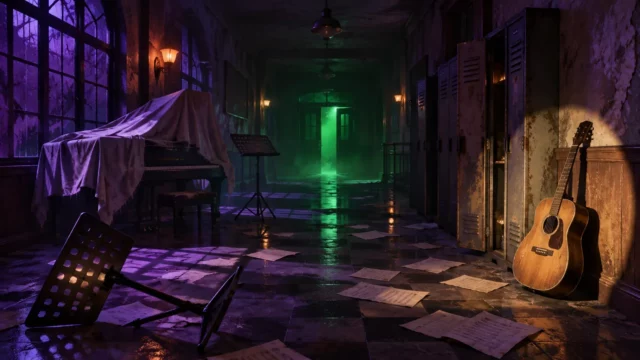
Making noise is usually a terrible idea in a horror game. In Don’t Fret, however, staying silent isn’t always an option. This unusual first-person psychological horror adventure puts players in control of a living guitar, turning music into a tool for survival, a way to solve mysteries, and a potential invitation for something terrifying to find you.
Developed by Scary Kid Studios, Don’t Fret is scheduled to launch on December 8, 2026, for PS5, Xbox Series X|S, and PC. Its unsettling music school promises more than jump scares, with enemies that respond to sound, instrument-based puzzles, and a story about identity and exploitation.
Don’t Fret arrives in December with a strange musical nightmare
The adventure begins when you awaken as Fret, a talented, sentient guitar trapped inside Harmonic Heights. On the surface, this prestigious music school seems dedicated to artistic excellence. Unfortunately, something much darker lurks behind its classrooms and corridors.
Escaping means discovering why Fret ended up there. Along the way, players must avoid dangerous creatures, recover missing memories, and gradually uncover the institution’s secrets. According to the official Steam listing, music influences exploration, puzzles, and encounters rather than simply providing background atmosphere.
Here are the essential launch details:
- Release date: December 8, 2026.
- Platforms: PlayStation 5, Xbox Series X|S, and PC through Steam and Microsoft Store.
- Developer: Scary Kid Studios.
- Publishers: Digital Pajamas and Behaviour Interactive.
- Genre: First-person psychological mascot horror with stealth and puzzles.
- Languages on Steam: Interface and subtitles in nine languages, including Spanish (Spain).
Every sound could save you or reveal your hiding place
The most interesting part of Don’t Fret is its relationship with noise. Instead of treating sound as an atmospheric detail, the game makes it central to staying alive. A distraction might create an escape route, while careless movement could attract unwanted attention.
Not every creature behaves the same way, either. Some react strongly to movement and sound, others are fast and unpredictable, and certain threats cannot be fought. Consequently, players will need to adjust their approach instead of relying on one reliable trick.
The main gameplay mechanics include:
- Stealth: Break enemies’ line of sight, move quietly, and avoid detection.
- Sound distractions: Manipulate environmental objects and noises to lure threats away.
- Defensive movement: Dodge, stun, or outsmart attackers when escape routes disappear.
- Enemy awareness: Adapt to creatures with different reactions to sound, movement, and confrontation.
- Upgradeable tuner: Monitor health, stamina, and battery levels while detecting nearby threats through sound.
- Musical puzzles: Interact with pianos, drums, guitars, and harps to progress.
- G-PAD challenges: Solve guitar-inspired locking mechanisms, sometimes while danger approaches.
This creates an intriguing risk-and-reward system. You might need to produce sound to progress, yet doing so could expose your position. For players who enjoy psychological horror built around constant uncertainty, that conflict is worth watching.
Don’t Fret makes a guitar tuner part of the survival experience
One particularly clever design choice is the guitar tuner. Rather than relying entirely on conventional interface elements, the game uses this familiar musical accessory as a diegetic HUD, meaning its information belongs naturally within the fictional world.
It displays health, stamina, and battery levels. Moreover, it can detect nearby enemies through sound and receive upgrades that unlock additional abilities. That makes it both a survival instrument and a natural extension of Fret’s unusual identity.
Musical challenges follow a similar philosophy. Players won’t simply search for keys or memorize combinations. Instead, instruments become interactive obstacles, while the G-PAD introduces guitar-inspired locks that demand attention under pressure.
Solving a puzzle while something approaches could make even a familiar musical sequence feel uncomfortable. Importantly, that tension comes from the mechanics themselves, not just from a frightening setting.
Harmonic Heights hides a story about performance and identity
Beyond its unusual protagonist, the adventure explores more serious themes. Its narrative deals with exploitation, performance, and identity, suggesting that Harmonic Heights has a troubling relationship with the talented individuals passing through its halls.
Players will investigate dozens of handcrafted environments, including classrooms, underground tunnels, outdoor courtyards, and even gondola rides. Meanwhile, audio logs, inspectable objects, and cinematic cutscenes gradually reveal fragments of Fret’s forgotten past.
That structure gives exploration a clear purpose. Each discovered memory could help explain the protagonist’s situation, while the school’s changing environments offer opportunities to vary both puzzles and enemy encounters.
The soundtrack also has a notable contributor: Russell McKamey of Rockit Music. Given the importance of sound to gameplay, the musical direction will be especially interesting to experience.
Music could give this mascot horror adventure its own identity
Mascot horror often depends on recognizable creatures and disturbing locations. Here, the more distinctive idea is that the protagonist is an instrument, and the same sounds needed to make progress can also create danger.
It’s another unusual addition to the horror calendar. Elsewhere, Nightmare Operator explores supernatural combat against yokai, offering a different approach to confronting frightening enemies. Meanwhile, The Road of Dust and Sorrow has been delayed to February 2027.
For Don’t Fret, the biggest attraction isn’t simply playing as a guitar. It’s the possibility of turning every sound into a meaningful decision. If its stealth encounters, musical puzzles, and fragmented storytelling work together, Harmonic Heights could become a memorable place to get lost.
Don’t Fret arrives on December 8, when players will be able to step into Harmonic Heights for themselves.

Creator of the website, Pokemon trainer by nature. Trying to report on everything related to the world of video games, series and movies. Yu-Gi-Oh is my weakness, collecting cards since the dawn of time.

