



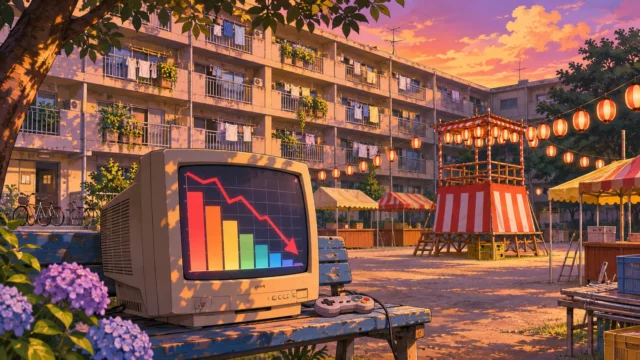
Getting 55,000 people to wishlist a game on Steam sounds like a promising start. However, Danchi Days has exposed a troubling gap between online interest and actual purchases. Its creator expected at least 5,000 sales during launch week. Instead, approximately 1,500 players bought the PC version, leaving a $200,000 project facing an unlikely return on its investment.
For Melos Han-Tani, the developer behind Anodyne and Angeline Era, the disappointing debut has raised a bigger question. What happens when thousands of potential customers appreciate a game’s appearance but never develop a strong reason to buy it?
Danchi Days launch sales reveal how misleading Steam wishlists can be
Released on October 29, 2026, Danchi Days is a five-chapter adventure developed under Han-Tani’s new studio, gingham games, and self-published. Although its launch generated considerable interest, the commercial results were far below expectations.
In his November 8 newsletter, Wishlist Woes and Post-Cozy Problems, Han-Tani shared the figures behind the disappointing release. Rather than simply blaming Steam’s crowded marketplace, he examined how different audiences responded to the game.
Here are the key Danchi Days launch figures and the developer’s current forecasts:
- Steam release date: October 29, 2026, on PC.
- Wishlists at launch: Approximately 55,000 outstanding wishlists, from 60,000 total additions.
- Expected first-week sales: At least 5,000 copies.
- Actual first-week sales: Approximately 1,500 PC copies, around 30% of the target.
- First-week wishlist conversion: 2.2%, compared with the 6-7% Han-Tani considers acceptable.
- Peak concurrent players: Around 35-40, against an expectation of approximately 100.
- Development cost: Approximately $200,000.
- Projected first-year sales: Around 5,000 PC copies.
- Projected three-year sales: Approximately 10,000 copies in the PC sales forecast.
These projections are estimates rather than guaranteed outcomes. Nevertheless, the financial implications are serious. After considering development time, advertising, localization, Steam’s revenue share and discounts, Han-Tani believes the adventure is unlikely to recover its production costs.
Importantly, the disappointing sales will not close the studio. Angeline Era performed successfully last year, while self-publishing gives the team greater control over its business. That previous success provides some protection against the new game’s losses.
Not every Steam wishlist represents the same intention to buy
The most revealing part of this situation is not the total number of wishlists. It is where those wishlists came from. Han-Tani discovered that early followers of his work were substantially more likely to purchase Danchi Days than people who encountered it through advertising or gaming showcases.
For example, players who added the adventure to their wishlists during its September 2024 announcement converted at 7.4%. By comparison, the July 2026 group converted at just 1%. That difference suggests that the quality of interest mattered much more than the quantity of wishlists.
Based on his own data, Han-Tani ranked six wishlist sources by their relative likelihood of becoming purchases. These figures are comparative scores, not actual conversion percentages.
- 1. Announcement-period followers — 100: Existing fans familiar with the developer’s previous games show the strongest purchase intention.
- 2. Streamer audiences — 60: Viewers who watch early gameplay are more likely to understand what the experience offers.
- 3. Steam personalized calendar — 40: Users discovering upcoming releases through Steam’s recommendations may have relevant interests, although they often wishlist numerous games.
- 4. Organic visitors — 40: People finding the game without a specific advertising campaign show meaningful interest, but may not fully understand its mechanics.
- 5. Gaming showcase viewers — 25: Showcase appearances generate visibility, although many viewers save games without intending to purchase immediately.
- 6. Advertising clickers — 15: People arriving through paid promotions demonstrate the weakest relative purchase intention in his analysis.
A longtime fan is far more likely to buy than an ad click
In practical terms, Han-Tani estimates that a longtime fan is roughly seven to eight times more likely to purchase than someone acquired through an advertisement. Furthermore, between 10% and 15% of Danchi Days wishlists originated from Reddit advertising.
This distinction changes how its launch should be interpreted. A wishlist accumulated through genuine enthusiasm for a developer’s previous work is not equivalent to one generated by an attractive advertisement. Both increase the visible counter, but they do not necessarily represent equal commercial demand.
There is also an important limitation. Steam’s monthly wishlist data does not fully account for deletions within individual cohorts, meaning some calculated conversion rates may be slightly understated. Even so, the differences between acquisition sources remain substantial.
The real problem may be that Danchi Days looks like a different game
Beyond marketing statistics, Han-Tani identifies a more fundamental challenge. Danchi Days looks like a familiar cozy adventure, yet its actual design deliberately avoids many mechanics associated with that genre.
Set in a Japanese danchi, or apartment complex, during the 2000s, the story follows Hoshino, an elementary school girl living with her father and grandmother, who has dementia. Her objective is to revive the summer festival her grandmother once organized by persuading 51 neighbors to attend.
Players explore their surroundings, develop relationships through conversations and even browse a fictional retro internet. However, there is no conventional farming system, shop management or traditional quest log. Instead, the adventure emphasizes character interactions, community relationships and bittersweet storytelling.
Han-Tani describes this combination as post-cozy. Its colorful presentation draws inspiration from Sunday-morning anime such as Hamtaro and Ojamajo Doremi, but its narrative explores subjects that audiences may not immediately associate with such cheerful visuals.
That creates a difficult marketing contradiction. Players seeking a conventional cozy simulation may add the game to their wishlists because of its appearance, only to discover that its mechanics are different. Meanwhile, people who might appreciate its unusual narrative could overlook it because the artwork suggests something simpler.
Consequently, Danchi Days faces two separate challenges: attracting attention from the right audience and communicating its appeal before that audience loses interest.
Weak Steam follower growth offered a warning before release
Looking back, Han-Tani believes he placed too much confidence in the wishlist counter while overlooking other indicators. The game’s demo never experienced a major viral breakthrough on social media, despite receiving streamer coverage. Moreover, organic Steam follower growth remained relatively slow throughout development.
Those signals matter because wishlists can function as casual bookmarks rather than firm purchase commitments. A player might save an interesting-looking title during a showcase without ever returning to investigate it further.
For comparison, Battle4play recently examined ROB RUN’s Steam player numbers and reviews, illustrating another distinction between visible platform metrics and a game’s broader performance. Concurrent players, reviews, followers and purchases measure different behaviors, so no single statistic tells the entire story.
In Danchi Days’ case, even its peak concurrent player count fell short of expectations. Rather than approaching 100 simultaneous players, it reached approximately 35-40. Combined with the low conversion rate, that result reinforced the developer’s concerns about the audience’s actual purchase intentions.
Han-Tani does not consider launch timing, competing releases or economic conditions convincing explanations for this particular outcome. Instead, he believes the central problem developed over a much longer period, as marketing efforts accumulated wishlists without sufficiently demonstrating why people should buy the finished game.
Danchi Days could still find its audience without changing its identity
Despite the disappointing debut, Han-Tani has no intention of turning the adventure into a conventional farming simulator or replacing its distinctive artwork. Those changes might make its genre easier to recognize, but they would also undermine the experience he wanted to create.
Instead, his planned approach is to emphasize concrete gameplay mechanics and character interactions. Showing how conversations work, how neighbors influence the adventure and why its unusual structure matters could help potential buyers understand what they are purchasing.
There is an interesting contrast with CINERIS SOMNIA’s unexpected sales revival years after release. That Japanese indie adventure eventually benefited from renewed interest in dreamcore aesthetics, demonstrating how an unconventional game can reach a different audience long after its original debut.
Of course, that does not guarantee a similar recovery for Danchi Days. The two games have different circumstances, and Han-Tani’s own projections remain cautious. Nevertheless, the comparison shows why launch-week performance and long-term cultural relevance should not be treated as identical measures.
Switch and PlayStation versions are also planned for existing fans, although the developer expects those releases to do little more than break even over time. No specific console launch dates have been announced. Meanwhile, the PC version has a 10% Steam launch discount through November 13.
Ultimately, Danchi Days illustrates a difficult lesson for independent developers. Visibility can help a game get noticed, but it cannot automatically create an audience that understands and wants its mechanics. For Han-Tani, preserving the project’s artistic identity now matters more than reshaping it to satisfy familiar genre expectations. Whether that approach produces a longer commercial life remains to be seen.

Creator of the website, Pokemon trainer by nature. Trying to report on everything related to the world of video games, series and movies. Yu-Gi-Oh is my weakness, collecting cards since the dawn of time.

